Repair
How do I replace the garage door bottom seal?
Happening to you right now? Here's how we fix it: gap at the side of the door
The bottom seal is the rubber or vinyl strip (sometimes called the astragal) that runs along the very bottom of the door and presses against the floor. In Colorado it earns its keep against winter cold and blowing snow.
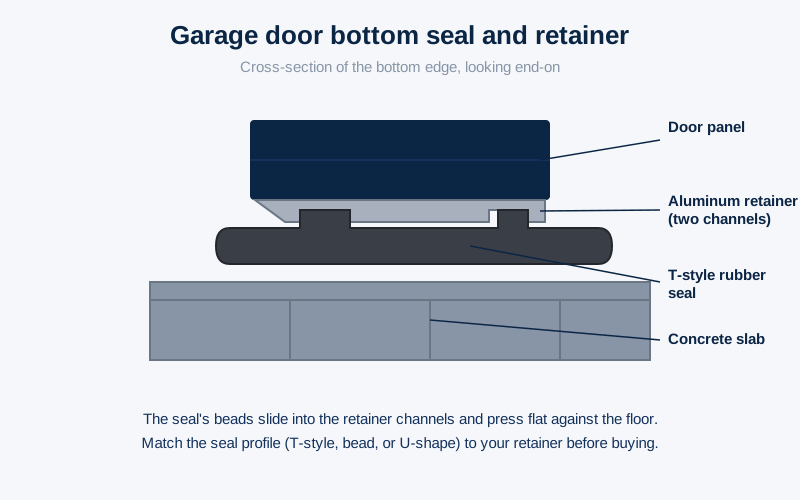
Identify your retainer and seal type
Before buying anything, look at the bottom edge of your door to see how the seal is held on. The seal type has to match the retainer.
- Aluminum retainer with two channels. Most modern steel doors have this. The seal has a T-shaped or double-bead edge that slides into the grooves. This is the easy case.
- Single-channel retainer. Older or lighter doors may use a one-groove track and a bead-style seal.
- Wood door with a nailed strip. Older wood doors often have a flat seal nailed or stapled to the bottom edge instead of a retainer.
Snap a photo of the end of the retainer so you can match the seal profile (T-style, bead, or U-shape) at the store. Buying the wrong profile is the most common mistake.
How to replace a garage door bottom seal
For the common aluminum two-channel retainer, the bottom seal replacement goes like this:
- Measure the door width and buy seal a little longer than that. Seal sells by the foot in standard widths.
- Open the door partway to a comfortable working height and support it, or work with the door down if you can reach the channel.
- Pull the old seal out from one end. It slides along the channels. Spraying a little soapy water in the track helps it move.
- Clean the retainer channels of dirt, old rubber bits, and grit so the new seal feeds smoothly.
- Feed the new seal in at one end, lining up its beads with the two channels. Soapy water as a lubricant makes this far easier. Pull it through to the other side.
- Trim the excess and center the seal so it overhangs evenly at both ends.
With the door closed, the new seal should press flat against the floor and close the gap. If your floor is uneven, a taller seal can bridge a low spot.
When the retainer itself needs work
Sometimes the seal is fine but the retainer is the problem. A bent, corroded, or missing retainer will not hold a new seal flat. Replacing the retainer means riveting or screwing a new aluminum track to the bottom of the door, which is a bigger job and one worth handing to a tech, especially on a heavy door where you would rather not fight the springs and balance.
Colorado winters are hard on the bottom edge. Road salt and snowmelt corrode the retainer and rot a cheap seal, so it is worth checking yours each fall. A fresh seal also helps the door not freeze to the slab when meltwater refreezes in the gap.
Keep the new seal lasting
A few habits make a seal last longer:
- Sweep grit and ice out of the channel so it cannot grind the rubber.
- Keep the bottom of the door and the floor clean where they meet.
- Pair the bottom seal with good side and top weatherstripping for a full seal, and keep the rollers and hinges lubricated so the door closes square. See our note on door lubrication.
If you still see daylight under a closed door after a new seal, the issue may be the floor or the door's balance rather than the rubber, which is covered in why there is a gap under the door.
When to call a pro
Swapping the rubber on a standard two-channel retainer is a fair DIY task. Call a tech when the retainer is damaged or missing, the door is heavy and hard to support, or a new seal still will not close the gap, which points to a door or floor issue.
Our crews across Denver, Lakewood, and the Front Range can replace seals and retainers, fix the underlying gap, and weatherproof the whole door, with flat-rate pricing. To get a drafty or leaking door sealed, call our 24/7 line at (720) 421-6489.
Related garage door guides
People also ask
Why is there a gap under my closed garage door?
A gap under your closed garage door usually means a worn bottom seal, uneven floor, bent track, or a door out of balance. Here is how to fix it.
Read full answerGarage door frozen to the ground? How to free it
Garage door frozen to the ground? Don't force the opener. Here is how to safely free a door frozen to the slab and keep it from freezing again this winter.
Read full answerHow do you replace the trim around a garage door?
Replacing garage door trim means replacing one of four different parts, and only two are DIY. Stop molding (the strip the door closes against) and exterior brickmold pry off and nail back on in an afternoon. Header flashing is a siding job. The jamb board carries the track, so leave it alone.
Read full answerHow do I replace the battery in my garage door remote?
Slide or pry open the remote's case, note the battery type (usually a CR2032, CR2016, or A23), and swap in a matching new one with the same side facing up.
Read full answerCurrent offers
Save while you are here
Browse our current specials and claim the one that fits your door.
$30 Garage Door Lube & Tune
Lubrication and adjustment with a 21-point safety inspection and a full sensor check. Catch small issues before they become expensive repairs.
Claim this offerUp to 10 Free Rollers with Garage Door Repair
Get up to 10 free standard garage door rollers with a garage door repair. The free rollers are the part only; labor is not included.
Claim this offerBuy One, Get One Free Garage Door Spring
Buy one garage door spring and get the second spring free, part only, when your door needs two springs.
Claim this offerHave a garage door problem now?
Tell us what your door is doing and we will tell you what is likely wrong and what it costs. Same-day service across the Denver metro.