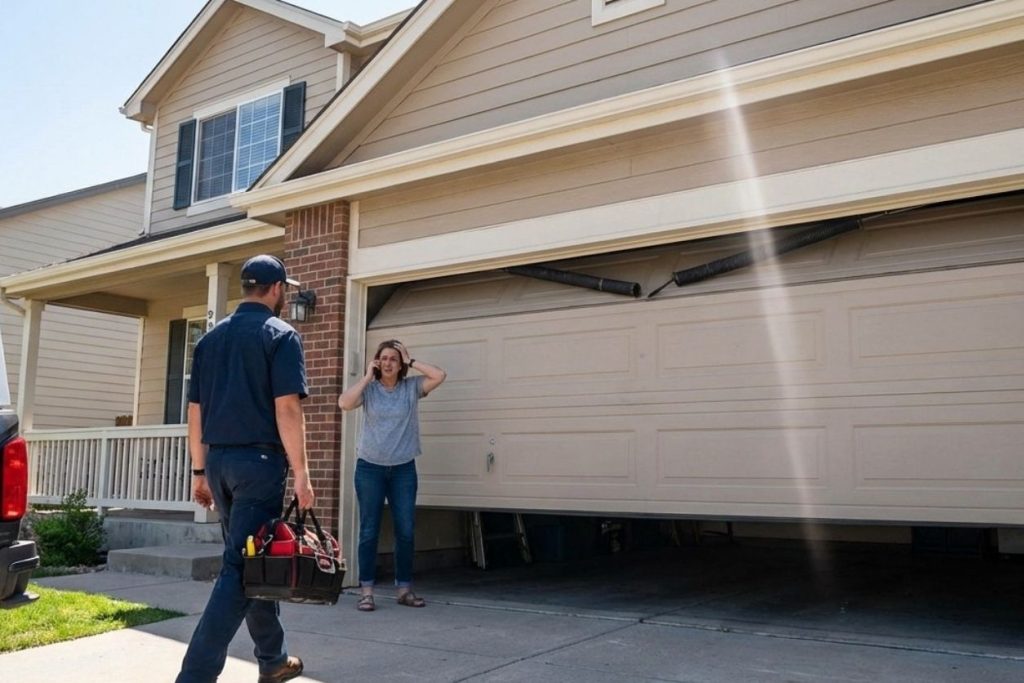
Garage Door Spring Replacement vs Repair: Which Do You Need?
A broken garage door spring cannot be repaired. Once the high-tension steel snaps, the only safe answer is full replacement. Welding the broken pieces is not a viable option: heat from a welding torch permanently changes the temper of the metal, and the repaired section will fail again the moment it goes back under load. The real questions are whether to replace one spring or both, and whether a standard spring or a longer-lasting high-cycle version is the right choice for your household.
Here is a clear breakdown of why repair is off the table, what replacement involves, and how to pick the right spring so you are not back in this situation in a year or two.
Why can a broken spring not simply be fixed?
Springs break because of metal fatigue. Every open-close cycle puts the steel through a twist or stretch. Over thousands of cycles, tiny stress fractures form inside the metal and grow until the coil snaps. By the time a spring breaks, the steel at the break point is structurally compromised and cannot safely hold tension again.
Two "repairs" get attempted and both fail:
- Welding the break. The heat destroys the temper of the high-carbon steel. A welded spring will snap again, sometimes violently, the first time it goes under the tension needed to lift the door.
- Adding tension to the surviving spring. If your door has two springs and one breaks, some people try to compensate by winding more tension into the intact one. This overstresses the remaining spring and accelerates its failure, often within days.
What professionals call "spring repair" is actually tension adjustment and lubrication on springs that are still intact but losing lift. That is maintenance, not a fix for a broken coil. Our detailed guide on repairing broken garage door springs explains the full replacement process step by step.
Should you replace one spring or both at the same time?
Replace both. If your door has two springs and one has broken, the second is the same age and has accumulated the same number of cycles. It is likely within a few hundred cycles of its own breaking point. Replacing only the broken one leaves you with one new spring and one on the verge of failure. Most households end up calling for a second service visit within weeks or months.
Doing both at once costs more in parts but saves a second labor charge and keeps the door running in balance. A door with mismatched springs is unevenly loaded, which puts extra stress on the opener and can twist the door in the tracks over time.
The comparison table above shows cost differences and cycle ratings so you can budget accurately before calling.
What is the difference between a standard spring and a high-cycle upgrade?
Standard builder-grade springs are rated for about 10,000 cycles. For a family that uses the door four times a day, that is roughly 7 years. High-cycle springs use heavier-gauge wire and are rated for 20,000 to 50,000 cycles. The chart below shows what that translates to in expected years of service.
A high-cycle upgrade costs roughly $150 to $200 more for a pair of springs. For a busy household, that premium pays for itself in avoided service calls within the second replacement period. Coated high-cycle springs resist the rust that Colorado's moisture and freeze-thaw cycles cause, which extends their life further. Our guide on how Colorado weather affects your springs explains why corrosion-resistant coatings matter on the Front Range.
What signs tell you a spring is close to failing before it snaps?
A spring does not always break without warning. Catching the early signs lets you replace it on your schedule rather than as an emergency:
- The door feels heavier than it used to. A spring losing tension transfers more of the door's weight to the opener. If the motor is working harder than before, the spring is wearing out.
- Uneven movement or a crooked door. If one spring is losing tension faster than the other, the door tilts as it travels. This is more common with extension springs on each side.
- Visible rust, gaps, or stretched coils. Look at the spring with the door closed. Rust, a slight gap in the coil, or visible stretching means the metal is near its limit.
- Loud popping or grinding noises. A spring that is dry or beginning to fail makes noise as it twists. That sound is worth investigating before a full break stops the door.
If you see any of those signs, read our guide on deciding whether you need a spring repair before the break leaves you stuck.
Why does Colorado weather shorten spring life?
Cold temperatures make steel brittle. A spring that might survive another season in a mild climate frequently snaps during the first deep freeze of a Colorado winter, when the metal contracts and the microscopic stress fractures shear through completely. Lakewood and Denver-area homes also see rapid temperature swings, sometimes 30 degrees in an afternoon, which put the metal through repeated expansion and contraction. That cycling on top of the door's mechanical cycles accelerates wear.
Springs without a corrosion-resistant coating also rust faster on the Front Range, where snow, road salt, and humidity from melt water get into uninsulated garages and sit on the metal.
What does professional spring replacement involve?
A technician secures the door so it cannot move, slowly unwinds the stored tension using properly sized winding bars, removes the damaged spring, and installs the correctly sized replacement. The new spring is wound to the precise number of turns for your door's height and weight, then the cables, rollers, and balance are checked before the door is tested.
The whole job typically takes about an hour for a straightforward torsion spring swap when the technician has the right parts on the truck. Contact G Brothers Garage Doors or call (720) 421-6489 for same-day garage door spring repair across the Denver metro, including Lakewood, Arvada, and Thornton.
Standard spring vs. high-cycle spring upgrade
The main decision after a break is whether to replace with a standard spring or invest in a high-cycle version. Here is how they compare.
| Factor | Standard spring | High-cycle upgrade |
|---|---|---|
| Cycle rating | About 10,000 cycles | 20,000 to 50,000 cycles |
| Expected life (4 cycles/day) | Roughly 7 years | 14 to 34 years |
| Installed cost (both springs) | $250 to $500 | $400 to $650 |
| Best for | Average use, budget-conscious | Busy households, commercial, rental |
| Coated for corrosion? | Usually not | Often yes (extends life further) |
Prices are typical for the Denver metro area and vary by door weight, size, and spring wire gauge.
Typical installed spring replacement cost (Denver area)
- One torsion spring
- $150 to $250
- Both torsion springs
- $250 to $500
- High-cycle upgrade (both)
- $400 to $650
- Extension springs (pair)
- $150 to $300
A standard garage door spring is rated for about 10,000 open-close cycles. That is roughly 7 years for a family that uses the door four times a day. High-cycle upgrades extend that to 20,000 or 50,000 cycles.
Source: Door & Access Systems Manufacturers Association (DASMA)
Sources and references
- 1.Garage door spring cycle life and safety standards — Door & Access Systems Manufacturers Association (DASMA)
- 2.Garage door safety guidance for homeowners — Door & Access Systems Manufacturers Association (DASMA)
- 3.Hazards of high-tension mechanical components — Occupational Safety and Health Administration (OSHA)
Part of this guide
Complete GuideUnderstanding Garage Door Spring Repair: What You Need to Know- What a Garage Door Spring Repair Involves: A Homeowner's GuideA broken garage door spring is the most common reason a door stops working. The spring does almost all the lifting, so when it fails the door becomes too heavy to raise safely. Replacement is a job for a trained technician, not a weekend project.Read guide
- Can You Open Your Garage Door With a Broken Spring?You can open a garage door with a broken spring, but only manually and only once to move your vehicle. A double door without springs weighs 150 to 300 pounds, so you need a helper and you should never run the opener. Get the spring replaced before using the door again.Read guide
- How to Decide If You Need a Garage Door Spring RepairIf your garage door will not open, feels heavy by hand, or a loud bang came from the garage, the spring is the most likely cause. A few quick checks can confirm it before you call for a repair.Read guide
- How Lakewood's Weather Impacts Your Garage Door SpringsGarage door springs in Lakewood and the Denver area wear out faster than the national average because of Colorado's freeze-thaw cycles, intense UV, and rapid temperature swings. Cold mornings in January and February are when most springs snap.Read guide
Technical resources
Related services
G Brothers provides these services across the Denver metro, from Lakewood and Arvada to Centennial and Thornton.
Frequently asked questions
How long do garage door springs last?
How long do garage door springs last? Most last 7 to 10 years, or about 10,000 cycles. Denver cold and daily use shorten that. Here's what affects it.
Read full answerHow much does garage door spring replacement cost?
How much does garage door spring replacement cost? Most Front Range jobs run $200 to $500 for a torsion spring. Here is what changes the price.
Read full answerTorsion vs extension springs: what's the difference?
Torsion vs extension springs: torsion mounts on a shaft above the door and lasts longer, while extension springs run along the tracks and cost less.
Read full answerIs DIY garage door spring replacement safe?
DIY garage door spring replacement is high risk. A torsion spring stores enough energy to break bones. Here is what goes wrong and when to call a pro.
Read full answerShould I replace one garage door spring or both?
Replacing one garage door spring to save money usually costs more later. On a two spring door, replacing both at once is the smarter call. Here is why.
Read full answerWhat are the signs my garage door needs repair?
The signs a garage door needs repair: new noises, a sagging door, slow or jerky movement, and a door that will not stay put halfway up.
Read full answerHave a garage door problem now?
Tell us what your door is doing and we will tell you what is likely wrong and what it costs. Same-day service across the Denver metro.