Repair
Torsion vs extension springs: what's the difference?
Happening to you right now? Here's how we fix it: converting springs to torsion
Knowing which system your door uses tells you what a repair will cost, how long it should last, and why neither spring is a safe DIY swap.
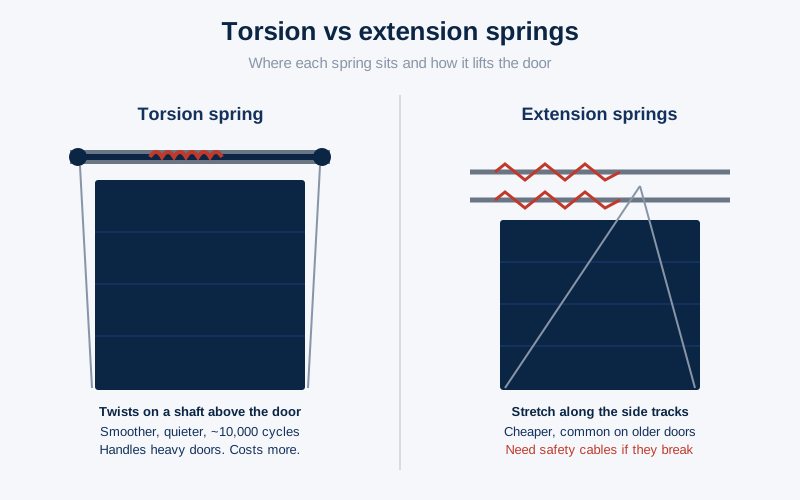
Torsion vs extension springs: how they differ
The quickest way to tell them apart is where they sit and how they store energy.
- Torsion springs mount on a steel shaft (the torsion bar) bolted to the wall just above the closed door. They wind up tight and use that twisting force to turn cable drums that lift the door.
- Extension springs stretch horizontally above the upper tracks, one on each side. They pull the door up by contracting as the door rises.
Torsion is the modern standard on most doors built in the last 20 years. Extension is the older design, still found on a lot of single-car and lighter doors around Denver.
How torsion springs work
A torsion spring lifts the whole weight of the door by twisting. As the door comes down, the spring winds up and stores energy. As the door opens, it unwinds and feeds that energy to the cables, so the door rises in balance and the opener only has to guide it.
Because the load is shared evenly across the shaft, torsion gives you a smoother, more controlled travel. The door doesn't bounce or jerk at the top. Torsion springs are rated by cycles (one open plus one close is a cycle), and a standard set is built for about 10,000 cycles, roughly 7 to 12 years of normal use. High-cycle springs rated for 15,000 to 30,000 cycles are available when you open the door many times a day.
Torsion also handles weight better. A heavy insulated steel or solid wood door needs the torque a torsion system delivers. That's why we fit torsion on almost every new install and most upgrades.
How extension springs work
Extension springs do the same counterbalancing job a different way. Instead of twisting, they stretch. When the door is down they are fully extended and loaded. As the door opens, they contract and pull the door up the tracks.
Extension is cheaper to buy and was the default for decades, so plenty of older Colorado garages still run it. The tradeoff is control and safety. Each spring works one side of the door, so a small difference between the two can leave the door slightly crooked or jerky. And when an extension spring breaks, it can fly across the garage with real force.
That last point is why a safety cable matters. A safety cable threads through the center of each extension spring and anchors at both ends, so a snapped spring is caught instead of launched. If your door has extension springs with no safety cables, that is the first thing to fix.
Which spring is right for your door
For most homeowners, the practical differences come down to lifespan, balance, safety, and price.
- Choose torsion if you want longer life, quieter and smoother operation, better balance, and the strength to lift a heavy or insulated door. It costs more up front and lasts longer.
- Extension can make sense if you have a light, single-car door, a tight budget, and headroom is limited (torsion needs clearance above the door for the shaft).
Many older doors can be converted from extension to torsion, which most techs recommend for the safety and longevity gain. Whichever system you have, replace springs in pairs. The second spring shares the same age and cycle count, so swapping both at once keeps the door balanced and saves a second visit. For how that affects the bill, see our note on whether to replace one spring or both and typical spring repair costs.
When to call a pro
Both spring types hold a large amount of stored energy, and both are pro-only work. Torsion springs have to be wound to an exact turn count with winding bars, and a slip can break a wrist or worse. Extension springs are under heavy stretch and snap toward you if released wrong. There is no version of this job that is safe with a screwdriver and a ladder.
A trained tech also picks the correct wire gauge, length, and cycle rating for your door's exact weight, which is what makes the new spring last.
If a spring on your door has broken or the door has gotten heavy, our crews across Denver, Lakewood, and the Front Range carry common torsion and extension sizes on the truck for same-day fixes. We can also convert an old extension setup to torsion. Call our 24/7 line at (720) 421-6489 or book through our spring repair service for flat-rate pricing.
Related garage door guides
People also ask
How much does garage door spring replacement cost?
How much does garage door spring replacement cost? Most Front Range jobs run $200 to $500 for a torsion spring. Here is what changes the price.
Read full answerShould I replace one garage door spring or both?
Replacing one garage door spring to save money usually costs more later. On a two spring door, replacing both at once is the smarter call. Here is why.
Read full answerWhy does my garage door slam shut instead of closing gently?
A garage door slams because it has lost counterbalance. The springs are no longer holding most of its weight, so gravity wins on the way down. The usual causes are a broken or fatigued spring, a cable off its drum, or a door never rebalanced after a repair. Opener force and limit settings are a separate, less common cause.
Read full answerCan I convert my garage door from extension springs to torsion springs?
Yes, converting from extension springs to a torsion spring system is possible on most residential doors.
Read full answerCurrent offers
Save while you are here
Browse our current specials and claim the one that fits your door.
$30 Garage Door Lube & Tune
Lubrication and adjustment with a 21-point safety inspection and a full sensor check. Catch small issues before they become expensive repairs.
Claim this offerUp to 10 Free Rollers with Garage Door Repair
Get up to 10 free standard garage door rollers with a garage door repair. The free rollers are the part only; labor is not included.
Claim this offerBuy One, Get One Free Garage Door Spring
Buy one garage door spring and get the second spring free, part only, when your door needs two springs.
Claim this offerHave a garage door problem now?
Tell us what your door is doing and we will tell you what is likely wrong and what it costs. Same-day service across the Denver metro.