Products & Upgrades
What horsepower garage door opener do I need?
Happening to you right now? Here's how we fix it: opener for a tall or 8-foot door
The right rating depends mostly on the door's material and size. Here is how to land on the correct horsepower for your door.
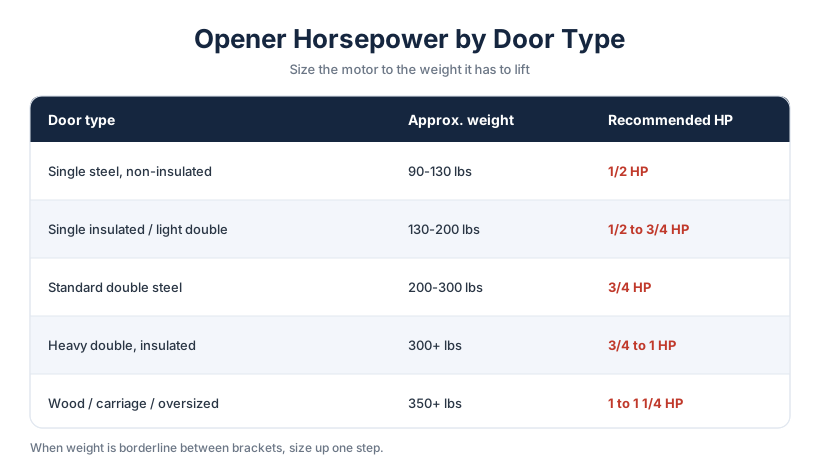
Garage door opener horsepower by door size and weight
Weight is what the motor fights, and weight comes from the door's size, material, and insulation.
| Door type | Approximate weight | Recommended horsepower |
|---|---|---|
| Single steel, non-insulated | 90 to 130 lbs | 1/2 HP |
| Single insulated or light double | 130 to 200 lbs | 1/2 to 3/4 HP |
| Standard double steel | 200 to 300 lbs | 3/4 HP |
| Heavy double, insulated | 300+ lbs | 3/4 to 1 HP |
| Wood, carriage, or oversized | 350+ lbs | 1 to 1 1/4 HP |
A few things shift the door into a higher bracket:
- Insulation adds a layer and real weight, especially on a double door.
- Wood and full-view glass doors are far heavier than steel of the same size.
- High-lift and oversized tracks ask more of the motor over a longer travel.
- Heavy daily use as a main entry favors a stronger motor that is not working at its limit.
What happens if the horsepower is too low
An underpowered opener does not just struggle on day one. It runs hot, strains its gears, and wears out years before it should. You may notice the door opening slowly, stalling partway, or reversing because the motor cannot pull the load. On a heavy door, a weak motor is the most common reason an opener fails early.
The flip side is worth knowing too. More horsepower does not make the door open faster. It gives the motor headroom so it lifts an everyday load without straining, which is why sizing up one step is a smart, low-cost choice for heavier doors.
A quick way to gauge weight without a scale: a single non-insulated steel door is light enough that one person can lift it by hand when the springs are disconnected, while a double insulated or wood door clearly takes two. If lifting the disconnected door feels heavy to you, it will feel heavy to an undersized motor too. When the weight is borderline between two brackets, the heavier bracket is the safer pick.
DC motors and horsepower-equivalent ratings
Newer openers, especially quiet belt and wall-mount units, often run DC motors rated in horsepower-equivalent terms, such as 3/4 HPS, rather than true horsepower. The "S" means the motor delivers lifting power similar to that horsepower class. DC units also bring soft start and stop, which is gentler on the door and quieter.
The practical takeaway is the same. Match the rating, true HP or HP-equivalent, to your door's weight class, and balance it against the drive type that fits your garage. A 3/4 HPS belt-drive and a 3/4 HP chain-drive lift about the same load.
Getting the right horsepower for your door
The surest way to size an opener is to weigh the choice against the actual door, since material and insulation move the number more than size alone. We measure the door, check its balance, and recommend the right horsepower and drive type before we quote. A door that is out of balance makes any motor work too hard, so we correct that first. We offer free estimates, flat-rate pricing, and same-day installs on most openers across the Denver metro. To match the right unit to your door, see our garage door services, or check the cost to install a garage door opener for the full price picture.
Size the motor to the weight it lifts, give it a little headroom on a heavy door, and the opener will run quiet and last the way it should.
People also ask
What is the best garage door opener type?
The best garage door opener type depends on your garage. Compare belt, chain, screw, and wall-mount drives to find the quietest, most reliable fit.
Read full answerWhat is the best garage door opener brand?
What is the best garage door opener brand? Compare LiftMaster, Chamberlain, and Genie on reliability, smart control, and long-term value for your home.
Read full answerWhat size and weight door can the Chamberlain B6755T handle?
The Chamberlain B6755T uses a 1-1/4 HP DC motor, the highest power rating in Chamberlain's residential lineup.
Read full answerWhat size and weight door can the Chamberlain B6753ST handle?
The Chamberlain B6753ST is rated at 1-1/4 HP and handles large, heavy residential doors including oversized two-car panels, thick insulated doors, and heavy carriage-style doors that would push a 3/4 HP motor near its limits.
Read full answerCurrent offers
Save while you are here
Browse our current specials and claim the one that fits your door.
$30 Garage Door Lube & Tune
Lubrication and adjustment with a 21-point safety inspection and a full sensor check. Catch small issues before they become expensive repairs.
Claim this offerUp to 10 Free Rollers with Garage Door Repair
Get up to 10 free standard garage door rollers with a garage door repair. The free rollers are the part only; labor is not included.
Claim this offerBuy One, Get One Free Garage Door Spring
Buy one garage door spring and get the second spring free, part only, when your door needs two springs.
Claim this offerHave a garage door problem now?
Tell us what your door is doing and we will tell you what is likely wrong and what it costs. Same-day service across the Denver metro.