Commercial
What types of commercial warehouse doors are there?
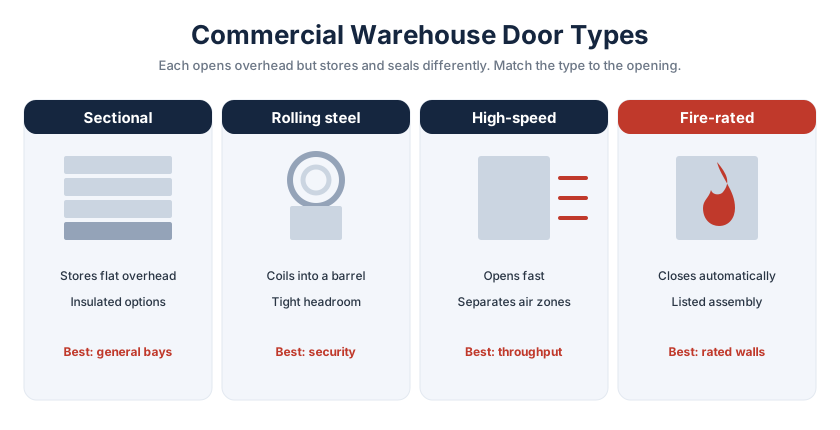
Here is how each type works and where it fits.
The main commercial warehouse doors
Most warehouse openings are served by one of these:
- Sectional overhead doors. Hinged horizontal panels that roll up on tracks and store flat under the ceiling. The default for most bays, available insulated for climate-controlled space.
- Rolling steel doors. Interlocking slats that coil into a barrel above the opening. Best where there is no room for horizontal tracks, or where security and durability come first.
- High-speed doors. Fast fabric or rubber doors that open and close quickly to keep traffic moving and separate air between zones, common at busy interior openings and cold storage.
- Fire-rated doors. Listed rolling or sectional doors that close automatically to hold back fire at a rated wall, required where the building code calls for a rated opening.
- Dock doors. Sectional or rolling doors paired with a leveler and seals at a loading position, built for trailer traffic.
These overlap; a fire-rated door can be a rolling steel door, and a dock door is usually a sectional. The label describes the job the door is doing.
How to choose between them
The choice comes down to matching the door to how the opening is used:
| Door type | Best for | Key strength |
|---|---|---|
| Sectional overhead | General warehouse bays | Insulation and a clean overhead store |
| Rolling steel | Tight headroom, security | Durability and a small overhead footprint |
| High-speed | High-traffic interior openings | Speed and air separation |
| Fire-rated | Code-required rated walls | Automatic closing for life safety |
| Dock | Trailer loading positions | Works with a leveler and seals |
Two questions settle most decisions: how many cycles a day does the door see, which sets the spring and operator spec, and how much headroom is above the opening, which decides whether a sectional, a high-lift, or a rolling door fits. Climate control, security, and throughput then narrow it further.
Matching the door to the building
A warehouse rarely needs only one type. A single building might run insulated sectional doors on the climate-controlled bays, rolling steel doors on the secure storage side, a high-speed door between zones, and fire-rated doors where the code requires them. The point is to size each opening to its real job rather than putting the same door everywhere. For a deeper look at the overhead designs behind several of these, see our guide to the commercial overhead door.
Getting the mix right is also what keeps maintenance predictable. Doors sized to their traffic fail less and cost less to keep running, while an under-built door on a busy opening becomes a recurring service call. The same logic applies to the parts inside each door: a high-traffic sectional benefits from high-cycle springs, while a quiet storage door does not, so matching the door type is only the first half of specifying it correctly.
Get the right doors specified
We install and service every one of these commercial warehouse doors across the Denver metro and the Front Range, and we will tell you honestly which type each opening calls for. Tell us the opening sizes, the ceiling heights, the traffic, and any code requirements, and we will spec the doors with flat-rate quotes and free estimates. See our commercial garage door services to get started, and we will match each bay to the door it actually needs.
People also ask
What is a commercial overhead door?
A commercial overhead door opens upward and stores overhead. Here are the main types, how they work, and how to pick the right one for your bay.
Read full answerDo you repair rolling steel doors?
Yes, we handle rolling steel door repair across Denver: jammed curtains, broken barrel springs, worn guides, bottom bars, and operator faults.
Read full answerWhat are fire-rated commercial doors and do I need one?
Fire-rated commercial doors close automatically to slow fire spread at rated walls. Here is how they work and where the building code requires them.
Read full answerDo you service loading dock doors and levelers?
Yes, we service loading dock doors and levelers across Denver: dock doors, seals, bumpers, and mechanical and hydraulic levelers as one position.
Read full answerCurrent offers
Save while you are here
Browse our current specials and claim the one that fits your door.
$30 Garage Door Lube & Tune
Lubrication and adjustment with a 21-point safety inspection and a full sensor check. Catch small issues before they become expensive repairs.
Claim this offerUp to 10 Free Rollers with Garage Door Repair
Get up to 10 free standard garage door rollers with a garage door repair. The free rollers are the part only; labor is not included.
Claim this offerBuy One, Get One Free Garage Door Spring
Buy one garage door spring and get the second spring free, part only, when your door needs two springs.
Claim this offerHave a garage door problem now?
Tell us what your door is doing and we will tell you what is likely wrong and what it costs. Same-day service across the Denver metro.